Showing posts with label Electronic Design Automation. Show all posts

Saturday, June 27, 2020

Arrays, Dynamic Arrays, Queues: One List to Rule them All


Randomizable lists are, of course, very important in modeling more-complex stimulus, and I've been working to support these within PyVSC recently. Thus far, PyVSC has attempted to stay as close as possible to both the feature set and, to the extent possible, the look and feel of SystemVerilog features for modeling constraints and coverage.  With randomizable lists, unlike other features, I've decided to diverge from the SystemVerilog. Keep reading to learn a bit more about the capabilities of randomizable lists in PyVSC and the reason from diverging from the SystemVerilog approach.

SystemVerilog: Three Lists with Different Capabilities
SystemVerilog is, of course, three or so languages in one. There's the synthesizable design subset used for capturing an RTL model of the design. There's the testbench subset that is an object-oriented language with classes, constraints, etc. There's also the assertion subset. These different subsets of the language have different requirements when it comes to data structures. These different requirements have led SystemVerilog to have three array- or list-like data structures:

Fixed-size arrays, as their name indicates, have a size specified as part of their declaration. A fixed-size array never changes size. Because  the array size is captured as part of the declaration, methods that operate on fixed-size arrays can only operate on a single-size array.

The size of dynamic-size arrays can change across a simulation. The size of a dynamic-size array is specified when it is created using the new operator. Once a dynamic-size array instance has been created, the only way to change its size is to re-create it with another new call. Well, actually, there is one other way. Randomizing a dynamic-size array also changes the size.

The size of a queue is changed by calling methods. Elements can be appended to the list, removed, etc. A queue is also re-sized when it is randomized.


PyVSC: One List with Three Options
If you've done a bit of Python programming, you're well aware that Python has a single list. Python's list is closest to SystemVerilog's queue data structure. My initial thought on supporting randomizable lists with PyVSC was just to create an equivalent to the list and be done. But then I thought a bit more about use models for arrays in verification. Each SystemVerilog array type represents a useful use model, but there's also another use model that I've never properly figured out how to easily represent in SystemVerilog. Fundamentally, there are two use cases for randomizable lists:
  • List with non-random elements
  • List with random elements, whose size is not random
  • List with random elements, whose size is random
When the size of a list whose size is not randomizable is modified by appending or removing elements, its size is preserved when the list is subsequently randomized.

Here are a few examples.

@vsc.randobj
class my_item_c(object):
    def __init__(self):
      self.my_l = vsc.rand_list_t(vsc.uint8_t(), 4)

The example above declares a list that initially contains four random elements.

@vsc.randobj
class my_item_c(object):
    def __init__(self):
      self.my_l = vsc.randsz_list_t(vsc.uint8_t())

    @vsc.constraint
    def my_l_c(self):
        self.my_l.size in vsc.rangelist((1,10))
The example above declares a list whose size will be randomized when the list is randomized. A list with randomized size must have a top-level constraint that specifies the maximum size of the list. Note that in this case the size of the list will be between 1 and 10.

If you wish to use a list of non-random values in constraints, you must store those values in an attribute of type list_t. This allows PyVSC to properly capture the constraints.
@vsc.randobj
class my_item_c(object):
    def __init__(self):
      self.a = vsc.rand_uint8_t()
      self.my_l = vsc.list_t(vsc.uint8_t(), 4)

      for i in range(10):
          self.my_l.append(i)

    @vsc.constraint
    def a_c(self):
      self.a in self.my_l

it = my_item_c()
it.my_l.append(20)

with it.randomize_with(): 
      it.a == 20 

In the example above, the class contains a non-random list with values 0..9. After an instance of the class is created, the list is modified to also contain 20. Then we randomize the class with an additional constraint that a must be 20. This randomization will succeed because the my_l list does contain the value 20.

Using Lists in Foreach Constraints 

PyVSC now also supports the foreach constraint. By default, a foreach constraint provides a reference to each element of the array. 
@vsc.randobj
class my_s(object):
    def __init__(self);
        self.my_l = vsc.rand_list_t(vsc.uint8_t(), 4)

    @vsc.constraint
    def my_l_c(self):
        with vsc.foreach(self.my_l) as it:
            it < 10
In the example above, we constrain each element of the list to have a value less then 10. However, it can also be useful to have an index to use in computing values. The foreach construct allows the user to request that an index variable be provided instead.
@vsc.randobj
class my_s(object):
    def __init__(self);
        self.my_l = vsc.rand_list_t(vsc.uint8_t(), 4)

    @vsc.constraint
    def my_l_c(self):
        with vsc.foreach(self.my_l, idx=True) as i:
            self.my_l[i] < 10
The example above is identical semantically to the previous one. However, in this case we refer to elements of the list by their index. But, what if we want both index and value iterator?
@vsc.randobj
class my_s(object):
    def __init__(self);
        self.my_l = vsc.rand_list_t(vsc.uint8_t(), 4)

    @vsc.constraint
    def my_l_c(self):
        with vsc.foreach(self.my_l, it=True, idx=True) as (i,it):
            it == (i+1)

Just specify both 'it=True' and 'idx=True' and both index and value-reference iterator will be provided.

One List to Rule them All
As of the 0.0.4 release (available now!) PyVSC supports lists of randomizable elements whose size is either fixed or variable with respect to randomization. Check it out and see how it helps in modeling more-complex verification scenarios in Python!

Disclaimer
The views and opinions expressed above are solely those of the author and do not represent those of my employer or any other party.


Saturday, November 30, 2019

Adding Task-Based Bus Functional Models to Cocotb


Getting a project started -- even to a certain level of completeness -- is often pretty simple. A couple weekends of hacking often results in pretty good progress and results. Finishing things up, in contrast, is often a slow process. That has certainly been the case with some work I did back in May and June this year to prototype a task-based interface between Python and an HDL simulator. The proof-of-concept work I did at the time seemed quite promising, but the clear next step was to make that work more accessible to others. That "last little bit of work" has certainly turned out to take more time that I had originally assumed!

Just as a reminder, the motivation for interacting with an HDL environment at the task level is quite simple: performance. Communicating across language (especially interpreted language) boundaries tends to be expensive, so minimizing the number of cross-language communications is critical to achieving high throughput. Using a task-based interface between Python and an HDL environment boosts performance in three ways. First, a task-based interface groups data so fewer language-boundary crossings are required to communicate a given amount of data. Secondly, and more importantly, using a task-based interface enables the HDL environment to filter events and only interact with the Python environment when absolutely necessary. Finally, using a task-based interface enables integrations with high(er)-speed environments, such as emulation or the current release of Verilator, where signal-level integration isn't practical.

I started looking at Python as a testbench language for reasons that might initially seem strange: the Python ecosystem (primarily PyPi) that makes it easy to publish bits of library and utility code in a way that it is easily-accessible to others. Often, the ability to take advantage of the work of others is gated by the effort required to gather all the required software dependencies. The Python ecosystem promises to alleviate that challenge, and I was excited to explore the possibilities.

Where Does it Fit?
I'm aware of a few projects that use Python for verification, but it currently appears that Cocotb is the most visible Python-based testbench for doing hardware verification using Python testbench code. Consequently, it made very good sense to see whether the task-based integration I had prototyped could be integrated with the existing Cocotb library.

Cocotb is a Python library that supports light-weight concurrency via co-routines, and provides primitives for coordinating these co-routines with each other and with activity in a HDL simulation environment. In addition to the Python library, Cocotb provides native-compiled C/C++ libraries that integrate with the simulation environment via APIS implemented by the simulator (VPI, DPI, FLI, or VHPI depending on the simulator). Currently, Cocotb interacts with simulation environments at the signal level.

In considering how to add task-based interactions to Cocotb, there were a several requirements that I thought were quite important. First, the user should not be forced to choose between signal-level and task-based interactions between Python and HDL. It should be possible to introduce task-based interactions to a testbench currently interacting at the signal level, or add a few signal-based interactions to a testbench that primarily interacts at the task level. Secondly, a task-based integration must support a range of simulator APIs. I had prototyped a DPI-based integration, which is supported by SystemVerilog simulators, supporting Verilog and VHDL simulators as well was clearly important. Finally, achieving good performance was a key requirement, since performance is the primary motivation for using a task-based interface in the first place.

Task-Based BFM Cocotb Architecture


From a system perspective, the diagram above captures how task-based BFMs integrate with Cocotb. Each BFM instance is represented in the HDL environment by an instance of an HDL module. This module is special, in that it knows how to accept and make task calls and convert between signal-level information and those task calls.

Each BFM also knows how to register itself with a BFM Manager within Cocotb. When the HDL portion of a BFM registers with Cocotb, the BFM Manager creates an instance of a Python class that represents the BFM within the Python environment.

The BFM Manager provides methods to allow the user's test code to query the available BFMs and obtain a handle to the BFM instances required by the test. From there, the user's test simply calls methods on the Python class object and/or receives callbacks.

Task-Based BFM Architecture

Let's take a quick look at the work needed to support a task-based BFM. First off, the BFM author needs to a Python class to implement the Python side of the BFM. That class is decorated with a @cocotb.bfm decorator that associates HDL template files with the BFM class. Below is a BFM for a simple ready/valid protocol.

@cocotb.bfm(hdl={
    cocotb.bfm_vlog : cocotb.bfm_hdl_path(__file__,   "hdl/rv_data_out_bfm.v"),
    cocotb.bfm_sv   : cocotb.bfm_hdl_path(__file__, "hdl/rv_data_out_bfm.v")
})
class ReadyValidDataOutBFM():
    # ...


Next, the BFM author must specify the low-level interaction API with the HDL BFM. All calls must be non-blocking, so most interactions with the HDL environment are implemented as a request/acknowledge pair of API calls.

    @cocotb.bfm_import(cocotb.bfm_uint32_t)
    def write_req(self, d):
        pass
    
    @cocotb.bfm_export()
    def write_ack(self):
        self.ack_ev.set()

Calling a class methods decorated with @cocotb.bfm_import will result in a task call in the HDL BFM. Class methods decorated with @cocotb.bfm_export can be called from the HDL BFM.

Finally, on the Python side, the BFM author will likely provide a convenience API to simplify the testwriter's life:

    @cocotb.coroutine
    def write_c(self, data):
        '''
        Writes the specified data word to the interface
        '''
        
        yield self.busy.acquire()
        self.write_req(data)

        # Wait for acknowledge of the transfer
        yield self.ack_ev.wait()
        self.ack_ev.clear()

        self.busy.release()


There's one piece left, and that's the HDL BFM. This is specified as a template:

module rv_data_out_bfm #(
parameter DATA_WIDTH = 8
) (
input clock,
input reset,
output reg[DATA_WIDTH-1:0] data,
output reg data_valid,
input data_ready
);
reg[DATA_WIDTH-1:0] data_v = 0;
reg data_valid_v = 0;
always @(posedge clock) begin
if (reset) begin
data_valid <= 0;
data <= 0;
end else begin
if (data_valid_v) begin
data_valid <= 1;
data <= data_v;
data_valid_v = 0;
end
if (data_valid && data_ready) begin
write_ack();

if (!data_valid_v) begin
data_valid <= 0;
end
end
end
end
task write_req(reg[63:0] d);
begin
data_v = d;
data_valid_v = 1;
end
endtask

// Auto-generated code to implement the BFM API
${cocotb_bfm_api_impl}

endmodule

The BFM author must implement tasks that will be called from the Python class. Task proxies that will invoke Python methods are implemented by the Cocotb automation, and substituted into the template where the ${cocotb_bfm_api_impl} tag is specified.

Current Integrations
Currently, task-based BFM integrations are implemented for Verilog via the VPI interface and for SystemVerilog via the DPI interface. A VHDL integration isn't currently supported, but that's on the roadmap. One complication with VHDL is that there are actually several interfaces that may need to be supported depending on the simulator -- VHPI, VHPI via VPI, Modelsim FLI. Here I could use some input from the community on priorities, so I'd definitely like to hear from you if you're using Cocotb with VHDL...

Results
As I mentioned at the beginning of this post, performance is the primary reason for using task-based interaction between Python and a HDL environment. So, how much improvement can you expect? Well, that entirely depends on how frequently your tests interact with the HDL environment and, to a certain extent, on how long your tests are. If your testbench needs to interact with the testbench every clock cycle, then you're unlikely to see much benefit. If, however, your testbench spends quite a few cycles waiting for the design to respond, then you're likely to see pretty significant benefits.

I'll use my FWRISC (Featherweight RISC) RISCV core as an example. In this environment, the bulk of the test is actually compiled code that executes on the processor. The Python testbench is primarily responsible for checking results and providing debug information when needed.
A diagram of the simulation-based testbench is shown above. The Tracer BFM is responsible for monitoring execution of the FWRISC core and sending events up to the high-level testbench as needed. These events include:
  • Instruction executed
  • Register written
  • Memory written
I've created two Cocotb implementations of this BFM: one that interacts at the signal level, and one that interacts at the task level. To compare the performance, I'm running a Zephyr test with Icarus Verilog for 10ms of simulation time.

Let's start with as close to a direct comparison as possible. Both the signal-level and task-based BFM will capture the same information and propagate it to the Python testbench.
  • Signal-Level BFM: 85s (wallclock)
  • Task-Level BFM: 33s (wallclock)
Okay, so already we're looking pretty good. This performance increase is simply because the task-based BFM doesn't need to call the Python environment every cycle. 

Another way we can benefit is to use a higher-performance simulator. Icarus Verilog is interpreted, and supports a full event-driven simulation environment. Verilator has a much more restricted set of features (synthesizable Verilog only, limited signal-level access, etc), but is also much faster. It also doesn't currently support the signal-level access to the extent necessary to do a direct comparison between a task-based BFM and a signal-level BFM. So, how do we look here? I actually had to increase the simulation time to 100ms (10x longer) to get a meaningful reading.
  • Task-Level BFM: 18s (wallclock)
So, coupling a fast execution platform with an efficient integration mechanism definitely brings benefits!

Next Steps
So, where do we go from here? Well, please stay tuned for my next blog post to get more details on how create task-based BFMs using these features. I also have an active pull request (#1217) to get this support merged into Cocotb directly. Until then, you can always access the code here


Disclaimer
The views and opinions expressed above are solely those of the author and do not represent those of my employer or any other party.

Saturday, June 8, 2019

Py-HPI: A Procedural HDL/Python Integration


As I mentioned in my last post, I've been looking at using Python for more tasks, including functional verification. My go-to languages for functional verification have traditionally been SystemVerilog for professional work, and C++ when I'm working on a personal project. I've started doing more of my small-application development in Python (often as an alternative to C++), and have wondered whether I could also migrate my testbench development from C++ to Python as well.

This blog post provides an introduction to an integration I created between Python and an hardware descriptin language (HDL) simulation environment called Py-HPI (for Python HDL Procedural Interface). I'm far from the first to create an integration between Python and an HDL simulator (I'm aware of at least one formal project, and several others users that have written about their integration work), so what is different about Py-HPI?

Well, two things, really in my opinion: 
  • Py-HPI integrates at the procedural level, which means Python can directly call tasks in the HDL environment instead of interacting with signals in the HDL environment. 
  • Py-HPI provides a high degree of automation for setting up this procedural-level integration.
In this blog post, I will be describing the user experience in using Py-HPI. In future blog posts, I'll walk through how Py-HPI integrates on my go-to project for playing with verification technologies, and I'll go more in-depth on how Bus Functional Models (BFMs) and testbench environments are developed for Py-HPI.

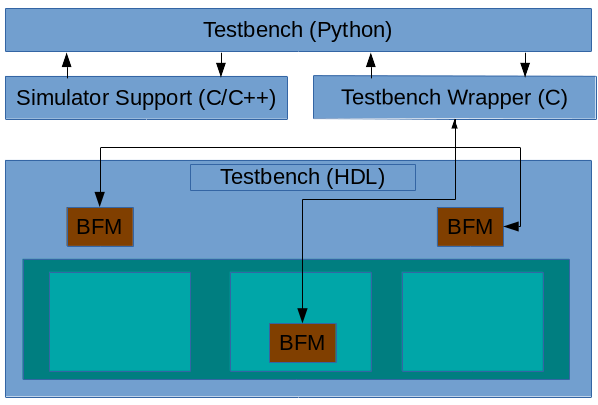
Py-HPI: The Big Picture


The structure of a Py-HPI enabled testbench is shown above. The key elements are described below
  • Testbench (Python) -- This is Python code the user writes to interact with the design running within the HDL simulation environment
  • Simulator Support -- This is C/C++ code generated by Py-HPI that implements the integration with a specific type of simulator. In general, this code is independent of the specific testbench
  • Testbench Wrapper -- This is C code generated by Py-HPI that implements the testbench specifics of the integration between Python and the HDL environment
  • Bus Functional Models (BFMs) -- BFMs written in HDL (eg SystemVerilog) implement the translation between task calls and signal activity and vice versa.
Currently, Py-HPI supports standard SystemVerilog-DPI simulators (eg Modelsim) as well as Verilator. More integrations are planned, including support for Verilog simulators like Icarus Verilog.

Py-HPI: A Small Example


One easy way to get a sense for the user experience when using Py-HPI is to walk through the steps to run a very simple testbench environment. One of the Py-HPI examples provides just such a testbench.
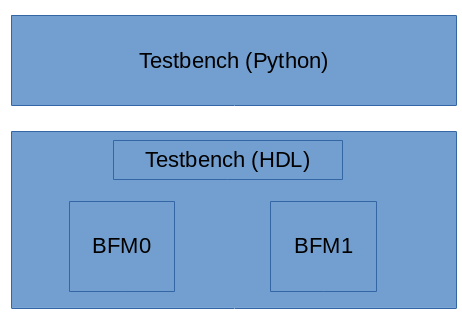
The structure of this testbench environment is shown above. The Python portion of the testbench drives the SystemVerilog HDL testbench via two bus functional models that are instanced in the SystemVerilog environment.

Python Testbench

First, let's take a look at the Python testbench code, which you can find here:
def thread_func_1():
  print("thread_func_1")
  my_bfm = hpi.rgy.bfm_list[0]
  for i in range(1000):
    my_bfm.xfer(i*2)

def thread_func_2():
  print("thread_func_2")
  my_bfm = hpi.rgy.bfm_list[1]
  for i in range(1000):
    my_bfm.xfer(i)

@hpi.entry
def run_my_tb():
    print("run_my_tb - bfms: " + str(len(hpi.rgy.bfm_list)))

    with hpi.fork() as f:
      f.task(lambda: thread_func_1());
      f.task(lambda: thread_func_2());

    print("end of run_my_tb");
Execution starts in the run_my_tb()method (which is marked by a special Python decorator hpi.entry, to identify it as a valid entry point) which starts two threads and waits for them to complete. Each of the thread methods (thread_func_1 and thread_func_2) obtain a handle to one of the BFM instances and call the BFM's API to perform data transfers in the SystemVerilog testbench environment.
In a way, it's almost identical to what I would write in either C++ or SystemVerilog. In a way, that's kind of the point from my perspective.

Running the Testbench

Okay, now that we know what the Python side of the testbench looks like, let's see the commands used to create and compile the files necessary to run a simulation. These commands are in the runit_vl.sh script inside the example directory. In this case, I'll show the commands required to run Py-HPI with the Verilator simulator. The example also provides a script (runit_ms.vl) that runs the same example with Modelsim.

Create the Simulation Support Files

We first need to create the simulation-support files. Since we're targeting the Verilator simulator, we need to run the 'gen-launcher-vl' subcommand implemented by the Py-HPI library.
python3 -m hpi gen-launcher-vl top -clk clk=1ns
Verilator is a bit of an outlier, in that the simulation-support files are specific to the HDL design being simulated. Consequently, we need to specify the name of the top Verilog module and the clock name and period.

Create the Testbench Wrapper

Now, we need to create the Testbench wrapper file that will support the specific BFMs instantiated inside the testbench. 
python3 -m hpi -m my_tb gen-bfm-wrapper simple_bfm -type sv-dpi
python3 -m hpi -m my_tb gen-dpi

Because the Verilator simulator supports DPI, we generate a DPI-based testbench wrapper for our testbench that uses a single BFM. The resulting testbench wrapper is implemented in C and provides the connection between SystemVerilog and Python for our BFM.

Compile Everything

This step is very specific to the simulator being used. 
# Query required compilation/linker flags from Python
CFLAGS="${CFLAGS} `python3-config --cflags`"
LDFLAGS="${LDFLAGS} `python3-config --ldflags`"

verilator --cc --exe -Wno-fatal --trace \
 top.sv simple_bfm.sv \
 launcher_vl.cpp pyhpi_dpi.c \
 -CFLAGS "${CFLAGS}" -LDFLAGS "${LDFLAGS}"

make -C obj_dir -f Vtop.mk
Since we're using Verilator, we need to run Verilator to compile the HDL files and the simulator-support and testbench wrapper C/C++ files. Verilator generates C++ source and a Makefile to build the final simulator image. Our last step is to build the Verilator simulation image using the Verilator-created Makefile.

Run it!

Finally, we can run our simulation.
./obj_dir/Vtop +hpi.load=my_tb +vl.timeout=1ms +vl.trace
We pass a few additional plusargs to enable specific behavior:

  • The +hpi.load=my_tb specifies the Python module to load
  • The +vl.timeout=1ms specifies that the simulation should run for a maximum of 1ms. Other simulators will, of course, provide different mechanisms for doing this
  • The +vl.trace argument specifies that waveforms should be created. Other simulators will provide different ways of turning on tracing.
So, all in all, Py-HPI makes it quite easy to connect a Python testbench to an HDL simulator at the procedural level.

Conclusion

In this blog post, I introduced Py-HPI, a procedural interface between Python and an HDL testbench environment along with an overview of the user experience when creating and running a testbench with Py-HPI. In my next post, I'll look at a Py-HPI testbench for my FWRISC RISC-V core and compare the new Python testbench with the existing C++ testbench. Until then, feel free to check out the Py-HPI library on GitHub (https://github.com/fvutils/py-hpi) and I'd be interested to hear your experiences in using Python for functional verification.


Disclaimer
The views and opinions expressed above are solely those of the author and do not represent those of my employer or any other party.


Sunday, January 13, 2019

EDAPack: Simplifying Development-Tool Management


One of my first "real" engineering courses during my college days centered around scripting and working with Unix, and the professor really emphasized that any repetitive task was a candidate for automation. It's a point that resonated with me at the time, and I continue to question whether any mind-numbing and multi-step process I face should be automated.

Challenges of Managing EDA Tools
One of those mind-numbing processes I've been facing recently is managing my installations of development tools -- specifically, the electronic design automation (EDA) tools that I use to simulate and synthesize Verilog hardware descriptions and develop the embedded software that runs on those devices.
In my experience, EDA tools are a bit different than the standard software that might be installed by default on your Linux workstation:
  • EDA software is enough of a niche market that builds will either just not be available for your Linux distribution, or will be an older version of the software.
  • I often need to install EDA software on machines where I don't have root access, so it wouldn't help me much if the Linux distribution provided a pre-built version of the software
  • I often don't have control over the Linux distribution and version that I have to use. CentOS/RHEL 6, released in 2011, is still quite common and will likely continue to be common since support is offered through 2020.
  • It's often necessary to have several versions of EDA software installed at a given time. Projects often have a dependency on a specific version -- at least until a newer version is validated, so multiple versions must coexist
These challenges, in and of themselves, make maintaining a collection of EDA tools time-consuming.

Challenges of Managing OSS EDA Tools
When it comes to working with open-source EDA tools, there is another level of complexity. These tools are often provided in source form, so they must be installed by the end user. EDA software, like any other, can be complex and can have dependencies on additional software packages. Compiling SymbiYosys, the open-source formal-analysis tool, requires that the source for seven other packages be fetched, compiled, and installed. This is complex enough when the user has administrator access to the machine and can install needed development libraries. Without administrator access, this process becomes incredibly complex. And, of course, when a new version of one of the packages is released, the whole process must be repeated.

Introducing EDAPack
I created EDAPack, which I consider to be in an Alpha state, to address the challenges I describe above. You can think of EDAPack has having two main components, as shown in the diagram below:


First off is the base set of tools, shown in the bottom box. EDAPack contains an installation of Environment Modules, which is a software package that is somewhat-widely used to manage configuring the environment for different software tools. Modules makes it easy to configure the environment with the right mix of tool versions with a minimum of fuss. EDAPack also contains an installation of Python3, a software package that is increasingly required to run open-source software tools, but is somewhat difficult to get correctly-installed on older Linux distributions. Finally, EDAPack contains scripts to manage installation of tools into the EDAPack tree.

The second part of EDAPack is most significant for those of you that are using open-source tools, such as a GCC cross-compiler or one of the open-source Verilog simulators. A key aspect of EDAPack's mission is to provide pre-compiled versions of these packages that can simply be installed and used, skipping all the complexities of installing development libraries and compiling required dependencies. Right now, just a few packages are setup to be used in this way, but the goal is to expand that set based on user demand.

Now, providing pre-compiled software is always an interesting proposition in a Linux environment. Different distributions provide different versions of tool and libraries, making it difficult to deliver software that will run on a variety of distributions. EDAPack compiles packages on CentOS 6, then tests the software on a variety of Linux distributions (courtesy of Docker), ensuring that the software will run correctly on a wide variety of Linux distributions.

How does it Work?
Getting started is actually pretty simple (and that's by design): just download EDAPack from the GitHub release page. After installing EDAPack, you'll want to source a setup script in the EDAPack 'etc' directory (<edapack>/etc/edapack.sh) in order to configure some initial paths.

From there, you'll probably want to install some software. This can be done using the edapack avail command to list software that is available to install:


Once you know which software you'd like to install, the edapack install command is used to  fetch and install the software into the EDAPack tree. For example, edapack install verilator fetches a pre-built version of Verilator from the release area on GitHub and installs it into the EDAPack tree.

Before using software from the EDAPack tree, you will use the module tool (provided by Environment Modules) to list the installed packages and load tools into your environment. Here's the output from module avail, which lists the installed tools. 

We can see that symbiyosys and verilator are installed. We can load a specific version of these tools, or specify the 'latest' version to get the newest installed version.

In other words, simply issuing the command module load verilator/latest will setup our environment to use the latest-installed version of Verilator.

Current Status and Call to Action

Currently, EDAPack is newly-released, provides a bare minimum of packages (Verilator, Icarus Verilog, and SymbiYosys), and provides support for Linux only. EDAPack is useful to me, and I'll continue to evolve it to meet my needs. However, I'm very interested in whether EDAPack could be useful to you as well.

Are you an EDA user? What tools would you like to see delivered in this way? What OS (Linux distro or other) do you use, and would like to ensure is supported?

Are you an author of open-source engineering software? Would you like to have your software made available to users in this way?

Do you have other ideas of what might be possible with a framework like this?

EDAPack is designed to enable hardware and embedded-software developers focus on developing their designs, not on compiling their development tools. I'm interested in your input on whether you feel EDAPack is a useful concept and, if so, what could make it even more useful to you. Feel free to comment on the blog, or file requests on GitHub. What tools are in your pack?